
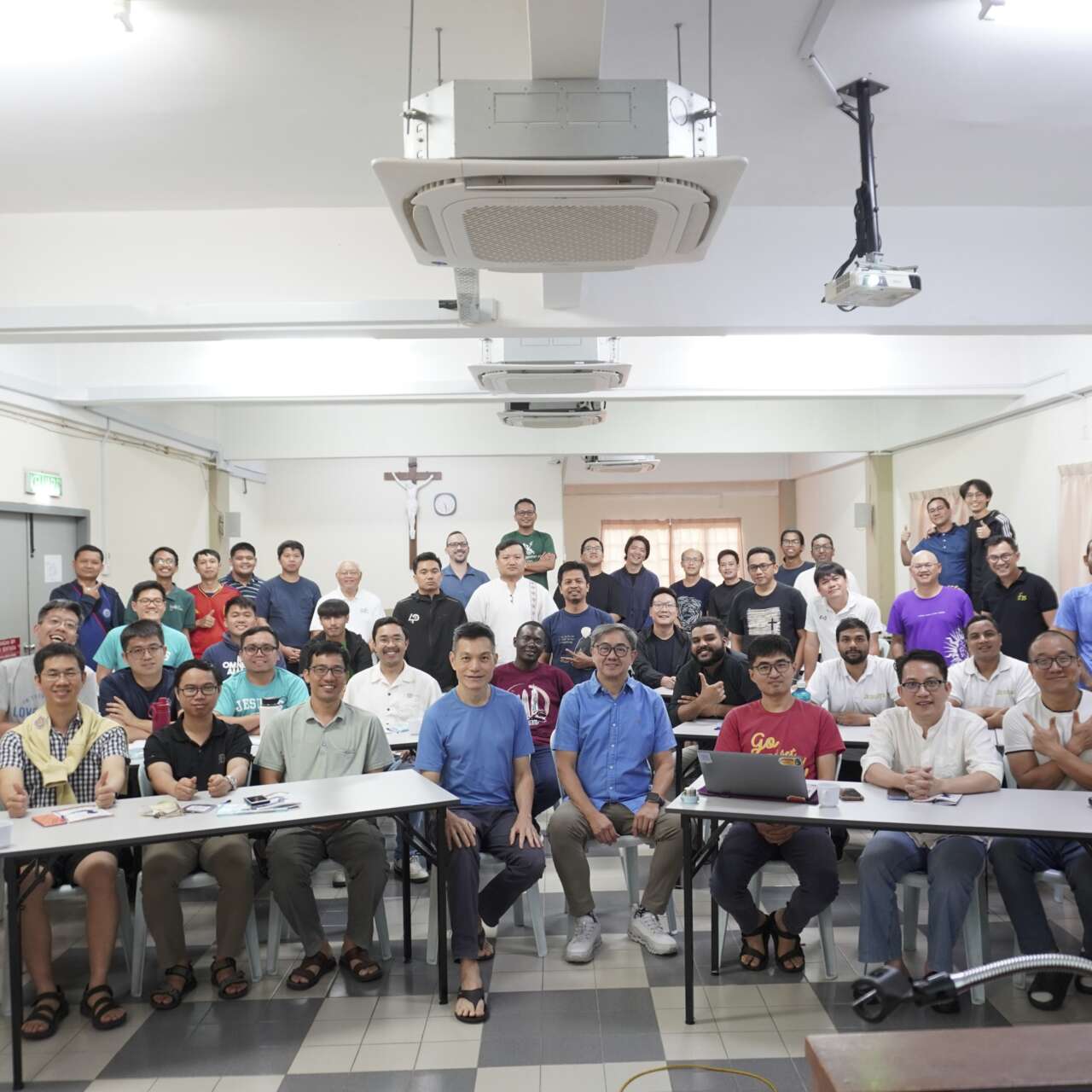
From 22 to 30 December 2025, Jesuit scholastics and brothers of the Jesuit Conference of Asia Pacific (JCAP), including scholastics from Brazil, Kenya, the United States and Pakistan, gathered at the Archdiocesan Pastoral Center (APC) in Kuala Lumpur, Malaysia, to discuss the topic ‘The Burgeoning of AI in the Lives of Youth in the Digital World Today’. During our week-long meeting, we had various resource persons deliver different themes aimed at helping us understand what AI is, what the capabilities of AI are, how AI is affecting the lives of young people, and what actions we can take to address the growing domination of AI.
Mr. William Tjhi, an AI expert and the head of SEA-LION AI in Singapore, shared with us his knowledge and understanding of the work of AI and how it shapes our lives. He addressed the question: Where are we now? Living in the digital world, our lives are closely connected to the development of artificial intelligence, particularly as we constantly engage with the tools of AI such as ChatGPT, NotebookLM, and Gamma.app, Gemini, Copilot, and other accessible tools. These instruments are capable of affecting human decision-making, problem-solving, and human creativity, providing an instant and quick response, and also helping increase the productivity of our work. Mr. Tjhi also shared how ‘machine learning’ infers rules from data, allows humans to collect the data, and transforms human (expert system) ability to interpret the data to narrow capabilities.
We also delved into an understanding of the capabilities of AI by creating music, dialogues, and conversations with AI, and by enhancing images. During his presentation, Mr. Darryl Ma also helped us explore how data analytics and financial accountability can be generated quickly and effectively through AI. This means that human work can become easier and save time and energy.
However, AI is not just a tool that can provide anything to its users. Mr. Benedict Chang helped us, the users, to be aware of the Positive Impacts, Negative Consequences, and Responsibilities of using AI. He highlighted that AI is no longer the technology for tomorrow, but it is in the present, pervasive, and shaping culture, social interaction, our future, and the way we look at reality.
Since in our everyday lives, we use smartphones, social media platforms, and AI tools, it is important to be aware of AI’s positive and negative effects. For Mr. Chang, when we engage with AI as a tool, it can either be used in positive ways—to enhance human capacities, promote human flourishing and dignity, support institutions—or it can lead to negative consequences such as human addiction to social media, lack of depth, decrease in critical thinking, loss of the meaning of the uniqueness of humans, and weakening of human values and relationships. In the kind of existence we have now, we as users have to be responsible for our lives, and questions such as “What makes us as human persons unique?” or “How does technology shape moral action?” can help us address and fulfil this responsibility.
We also need to reflect and think about possibilities and alternative ways to address AI, especially in ministry, study, formation, and relationships. As we neared the end of the program, Fr. Johny Go SJ invited us to reflect on our disposition as AI users. We can become an ‘AI optimist booster’, which means we are eager to reap its benefits, or we can become an ‘AI pessimist Doomster’, which means we are enthusiastic to use AI, but we are unaware of its consequences.
In this digital world, we need to question ourselves: are we cultivators of personal knowledge that leads us to the depth of ideas and to develop critical thinking, or are we hunters and gatherers of information in the Digital Forest which leads us to become information consumers? In order to address these questions, we should take action in leading the Gen Millennial, GenZ, Alpha, and everyone else who is in the AI-driven world to become aware of the effects of AI, because according to Yuval Noah Harrari “AI is not just a tool, but an agent”. In other words, AI is part of our human world, culture, and social interaction.
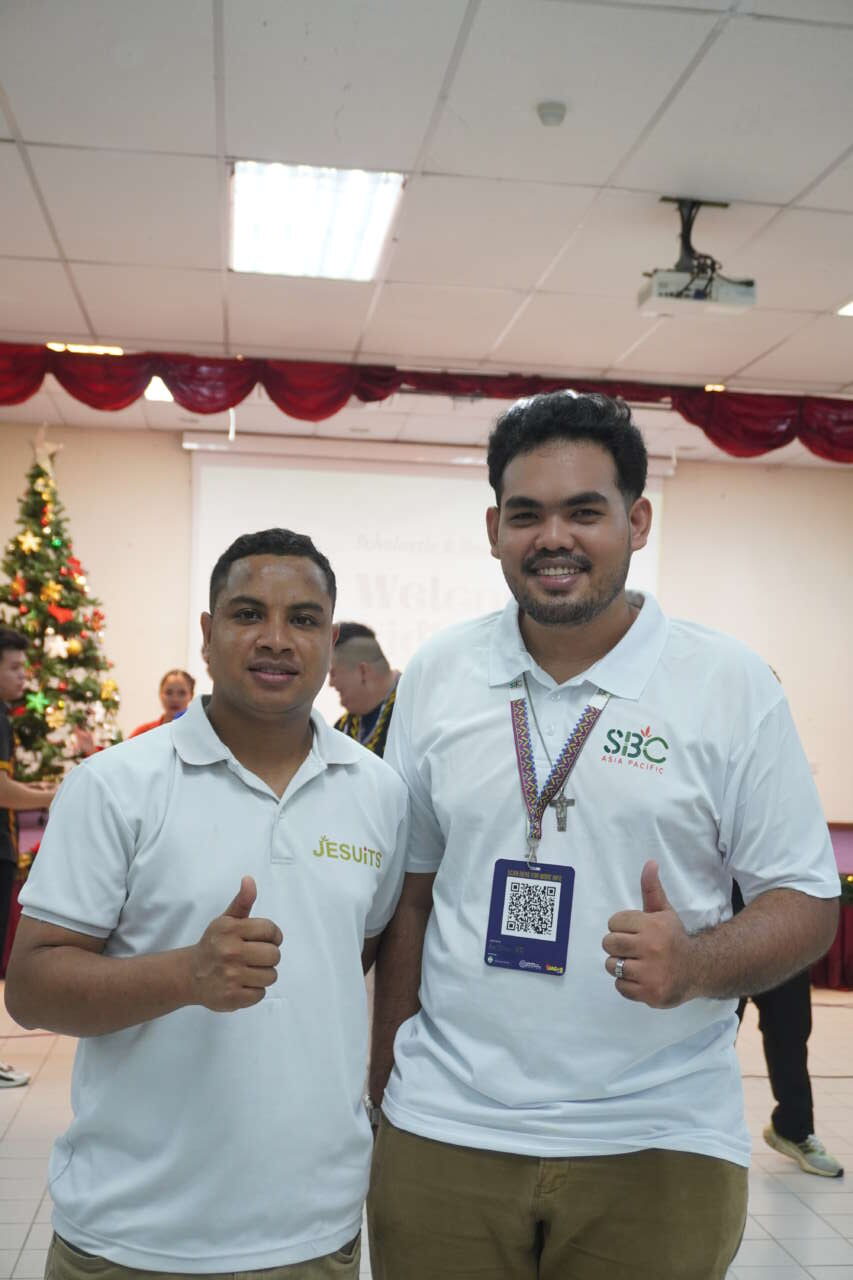
Finally, during our spiritual conversation sessions, we were invited to reflect on the need to look at the way in which we use devices for practical day-to-day things as a way to balance our lives in the world of AI. Some of our insights suggested that perhaps we can try to avoid using cellphones in our social interaction with others, develop our natural skills, delve into the depths of ideas, engage with nature, and be discerning persons, so that we may continue to flourish and live with dignity as humans.
Written by:
Sch. Jonas Carvalho Soares SJ