

Who is Ignatius of Loyola, the 16th-century Spanish saint who, together with his companions, founded the Society of Jesus? And why does the spiritual insight of this man continue to be relevant to men and women of the 21st century? These are interesting questions that can guide our reflection on his legacy to the Church as we approach his Feast Day on July 31.
As a Jesuit, Ignatius of Loyola became very familiar to me when I joined the Society, co-founded by him, as a novice in April 2004. However, without being fully aware of it, I had already received a certain ‘Ignatian’ influence during my secondary studies as a minor seminarian of the Seminário Menor de Nossa Senhora de Fátima de Balide and Kolese Sto. Yosef in Balide from July 1999 to May 2002. At that time, both institutions were still under the administration of the Jesuits.
Looking back and reflecting on my relationship with Ignatius of Loyola—through reading his Autobiography, Spiritual Diary, and the Constitutions he wrote, as well as practicing the Spiritual Exercises annually—one cannot help but be struck by certain qualities of this 16th-century saint.
The first quality of Ignatius that strikes me most is his deep search for his own truth. The knight Ignatius of the House of Loyola, inspired by chivalric culture, was always in search of the best possible knighthood. He wanted to win the attention of his dream lady of the Castilian court and defend his Majesty with honor, even if it meant sacrificing his own life. In his search for greatness, Ignatius spent his first 27 years in worldly adventures, as he describes in the opening lines of his Autobiography.
However, this Basque knight never felt fulfilled. He was always after what could be the “better” and was determined in this search. This was never a mere adventure; on the contrary, for Ignatius, it was a necessity. There had to be something greater and more fulfilling than what he had been striving for.
Life taught Ignatius where to find this greater fulfillment. After the cannonball experience at Pamplona, this restless Basque knight, who had been completely given over to worldly adventures, turned into a pilgrim. He was always on his way, unable to rest until he found what he was searching for. Indeed, Ignatius was a man of deep desires, and he was never afraid of them. Instead, he delved into them. Guided—and often confused—by his sometimes-conflicting desires, this pilgrim eventually found the only truth that could satisfy his feeling of being “never enough” and pacify his restlessness. After discerning, i.e., sorting out and examining the many desires that fueled his adventures, the pilgrim finally realized that only in God could he find rest and true fulfillment. As he wrote in the ‘Principle and Foundation’ of his Spiritual Exercises: “Human beings are created to praise, reverence, and serve God, and by this means to save their souls.”
The second quality that I admire in Ignatius is his devotion to Jesus. To praise, reverence, and serve God, he discovered that Jesus is the truest and most authentic example of living out this principle and foundation. Ignatius had a deep love for and devotion to Jesus. Hence, the grace he proposes for the retreatants in the Second Week of the Exercises is to gain an intimate knowledge of Our Lord and a deeper love for Him, so as to follow Him more closely. The centrality of Jesus in Ignatian spirituality can never be overemphasized.
In his Autobiography, we learn that his devotion and desire to be close to Jesus were so profound that he decided to go to Jerusalem to walk where Jesus had walked. He wanted to be where Jesus was, to be associated and identified with Him, and to be his companion. This deep devotion was institutionalized in the religious order he co-founded, naming it Societas Iesu, the Society of Jesus (la Compañía de Jesús in Spanish). That is why this religious order was not named the “Ignatian Order”—because its center is not Ignatius of Loyola, but Jesus, the Son of God.
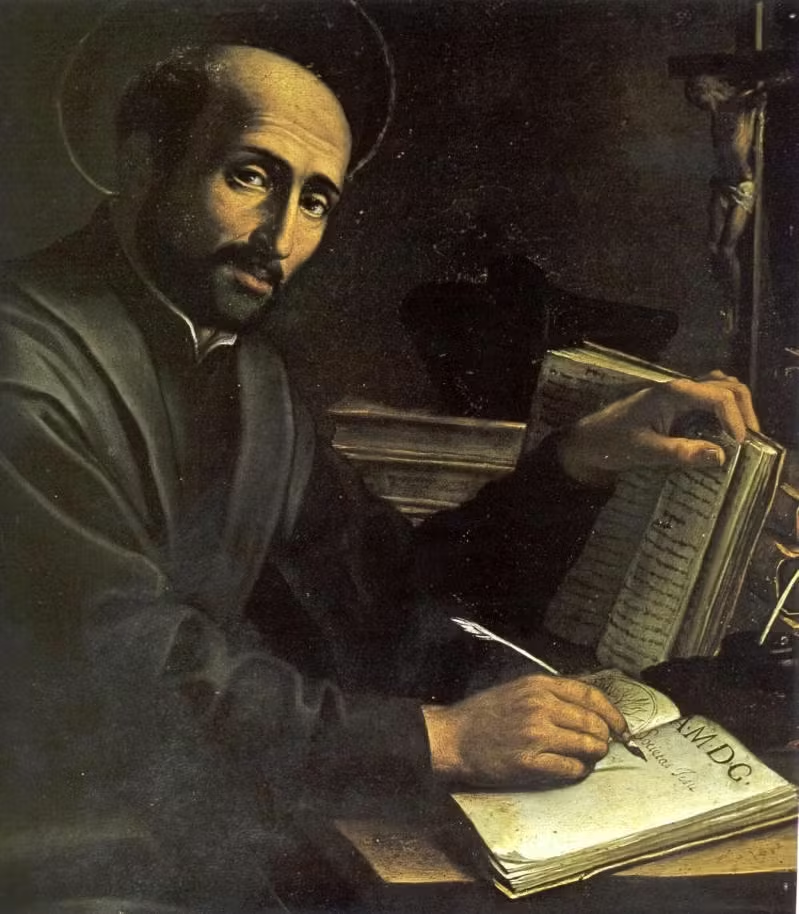
Image: St. Ignatius of Loyola. Founder and patron of the Society of Jesus (Jesuits).
The third quality I admire in Ignatius flows from the second. Those of us inspired by Ignatian spirituality are called to be companions of Jesus and companions of one another. It is in this companionship that each of us is called to praise, reverence, and serve God, to build His kingdom in this world. Indeed, as announced by the Gospels, Jesus came to proclaim that the Kingdom of God is at hand. As companions, we are gathered, like the disciples, to collaborate with Jesus in His mission.
This realization, if seriously reflected upon, can help us fight the temptation to privatize any apostolic endeavors of the Society of Jesus. Although individual commitment is a prerequisite, no individual Jesuit owns an apostolate. Our mission is Jesus’ mission. We are called to collaborate with Him in companionship. Indeed, all our missions should be carried out in companionship with Jesus and with one another.
Ignatius was a great collaborator in the mission of Jesus. Besides involving his companions, he included other collaborators—both clergy and laity—who became benefactors of the Society of Jesus. To maintain a close relationship with his collaborators, Ignatius wrote letters to encourage those facing difficulties in distant mission lands, and to express his gratitude for the generosity of benefactors who made the Society’s missions possible.
If asked, these are the three qualities I admire most in St. Ignatius of Loyola. Finally, if I were to meet him on his Feast Day on July 31, 2026, I would say to him: “Thank you for remaining relevant to us in the 21st century. You are still relevant because, in your search, you allowed God to guide you. If it had not been for God, and if you had not been open to Him dealing with you as a schoolmaster deal with a student, we would never have dared to call ourselves companions of Jesus.”
Written by:
Fr. Isaías Abílio Caldas, SJ (Rector of ISJB)